
Parents do not always need more communication from their childcare provider.
They need better communication.
That difference matters.
Most childcare centers are already exhausted from communicating. Daily reports. App notifications. Photo uploads. Weekly newsletters. Incident notes. Sign-in conversations. Late-pickup reminders. Behavior updates. Lost jacket messages. Billing questions. Calendar reminders.
By the time a teacher closes the classroom for the night, she may have “communicated” with families all day long — and somehow, there is still a parent who feels out of the loop.
That does not always mean the center failed.
Sometimes it means the communication system is doing too many things at once.
In early childhood education, strong family communication matters. NAEYC describes family engagement as a partnership built through regular, two-way communication, including informal conversations, conferences, phone calls, texts, emails, and other methods that help families and educators work together.
But communication should not cost teachers their evenings.
The answer is not to do more.
The answer is to design parent communication so every channel has a clear job.
Daily Communication Should Be Quick and Easy to Understand
Daily communication should give parents a one-glance picture of the day.
That is it.
Not a full journal entry.
Not a long paragraph.
Not a pressure-filled update that takes the teacher ten minutes per child.
Parents should be able to know, in less than thirty seconds, how their child’s day went.
A strong daily update may include:
Meals.
Nap.
Mood.
Bathroom or diaper notes.
One short comment.
Something like:
“Great day today. Ate well, took one long nap, enjoyed block play, and needed a little extra comfort after lunch but bounced back.”
That is enough.
The goal is not to write a story every day. The goal is to give parents peace of mind and enough information to feel connected.
Longer stories can happen at pickup, in a weekly note, or during a scheduled conversation.
Weekly Communication Should Build Community
The weekly message should remind families that they are part of something.
It does not need to be long.
A good weekly newsletter can be five sentences.
What did the children work on?
What is coming up?
What should parents know?
Is there one small ask?
That is it.
This is where a center builds culture.
A simple weekly message might say:
“This week, our preschoolers practiced sharing materials, recognizing letters, and using kind words with friends. Next week, we will begin our fall activities and continue working on classroom routines. Please send a light sweater as the mornings are getting cooler. Thank you for helping us make the classroom feel calm, safe, and connected.”
That kind of message does not have to be perfect.
It has to be consistent.
Consistency builds trust.
The Head Start Parent, Family, and Community Engagement Framework also emphasizes that family engagement should be part of program-wide planning, not something that happens randomly when there is a problem.
That is a helpful reminder for childcare centers.
Communication should have a rhythm.
Monthly Communication Should Handle Operations
Monthly communication should be calm, organized, and easy to find.
This is where you place the things parents need to plan around:
Closures.
Calendar dates.
Billing reminders.
Special events.
Picture days.
Policy reminders.
Field trips.
Holiday schedules.
Parent meetings.
The mistake many centers make is sending operational reminders in too many places.
One reminder is in the app.
Another is on the classroom door.
Another is in a group message.
Another is mentioned at pickup.
Another is buried inside a newsletter.
Then, when a parent says, “I didn’t know,” the provider feels frustrated.
But sometimes parents are not ignoring the message.
They are drowning in too many messages.
Put monthly operational updates in one clear place, and train families to look there.
Then remind them briefly, without rewriting the entire message five times.
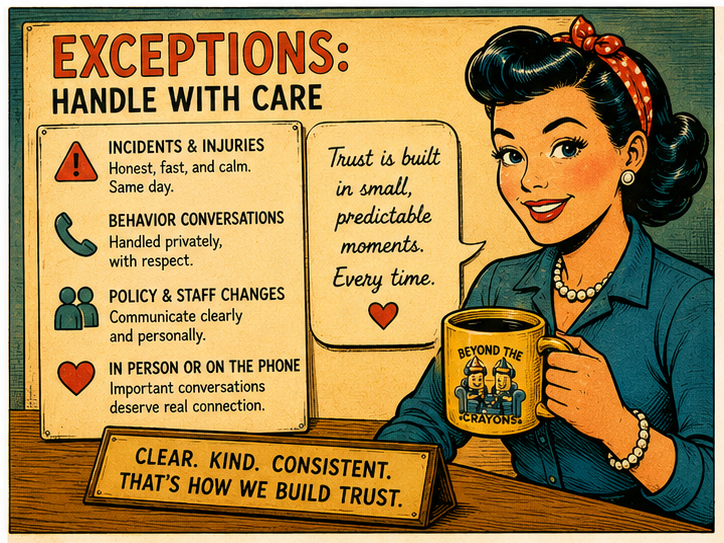
Exceptions Need a Different Kind of Communication
Not every message belongs in the daily report or newsletter.
Some things need individual care.
Incident notes.
Biting.
Injuries.
Behavior concerns.
Health exposures.
Teacher changes.
Policy changes.
Family concerns.
These are not routine updates.
They are trust moments.
For these situations, the message should be honest, timely, calm, and direct.
If a child was hurt, tell the parent what happened, what staff observed, what care was given, and what the next step is.
If there is a communicable disease exposure, parents need clear information. The California Childcare Health Program explains that providers are required to inform parents when children in care are exposed to a communicable disease, and those messages should be handled clearly and calmly.
Hard news should not sound dramatic.
It should sound steady.
Parents do not expect childcare centers to be perfect.
They do expect to hear important information from the provider first.
Use Templates Without Feeling Guilty
There is no shame in having a template for:
Late pickup reminders.
Incident reports.
Biting incidents.
Illness reminders.
First day updates.
Transition updates.
Closure reminders.
Tuition reminders.
Behavior meeting requests.
Teacher departure announcements.
Policy reminders.
Write the message once with care, then adjust it for the child and family.
The teachers who burn out fastest are often the ones writing every message from scratch, every time, while also managing children, cleaning the classroom, closing the room, and preparing for the next day.
Templates do not replace care.
They protect care.
They help the teacher communicate clearly without starting from zero every time.
Train Your Team on Pickup Handoffs
A thirty-second pickup conversation can do more for trust than a long app message.
“She had a great day. She ate well, took two short naps, and loved music time. She was a little emotional after lunch, but we gave her extra comfort and she bounced back.”
That kind of handoff matters.
Parents want to feel like someone noticed their child.
Apps are convenient.
Eye contact is different.
NAEYC’s guidance on engaging in reciprocal partnerships with families specifically includes informal conversations during drop-off and pickup as part of meaningful family communication.
That does not mean teachers need to have a long conversation with every parent every day.
It means the center should train staff to give short, useful, warm handoffs.
Especially when something felt different about the child’s day.
Be Honest, Fast, and Calm About Hard News
Trust is not built by pretending nothing ever goes wrong.
Trust is built when families see that the provider handles problems responsibly.
If a child gets bitten, tell the parent.
If there is an exposure, tell the parent.
If a teacher is leaving, tell the parent.
If there is a classroom change, tell the parent.
If something happened that could affect their child, they should not find out later from another parent, a staff member in passing, or a child’s half-version of the story.
The biggest trust breakdown is often not the incident itself.
It is the delay.
It is the silence.
It is the feeling that the parent had to discover the information instead of receiving it.
Say what happened.
Say what you did.
Say what happens next.
Do not over-explain.
Do not blame.
Do not dramatize.
Just be clear.
Set Real Quiet Hours
Childcare providers need communication boundaries.
Real ones.
A healthy message policy might say:
“We respond to non-urgent messages during business hours. For non-urgent questions, please allow one business day for a response. For emergencies, please call the center directly.”
That is reasonable.
Parents can respect boundaries when the center explains them clearly and follows them consistently.
The problem is when providers say they have quiet hours, but still answer every message at 9:30 p.m.
That trains families to expect evening responses.
Boundaries are not mean.
Boundaries protect the provider, the teachers, and the quality of the program.
A burned-out teacher does not communicate better.
A rested teacher does.
Choose the Right Channel for the Message
Every communication channel should have a purpose.
Daily app updates are for quick day-to-day notes.
Weekly newsletters are for classroom culture.
Monthly calendars are for operations.
Phone calls are for sensitive issues.
In-person conversations are for trust-building.
Written follow-ups are for documentation.
Group messages are for simple reminders, not complicated conversations.
When every channel does every job, families get confused and teachers get overwhelmed.
When every channel has a job, communication gets lighter.
Do Not Let Parent Communication Become Teacher Surveillance
Some centers unintentionally create a culture where teachers feel like they must prove they worked all day by sending constant pictures and updates.
That can backfire.
Parents want to feel informed, but teachers also need time to be fully present with children.
Strong communication should support the classroom, not interrupt it all day long.
The best updates are thoughtful, consistent, and useful.
Not constant.
Not performative.
Not stressful.
The goal is not to show every moment.
The goal is to help parents trust what is happening when they are not there.
Why This Matters
Parent communication is one of the strongest trust builders in childcare.
It affects retention.
It affects referrals.
It affects how parents respond when something hard happens.
It affects how supported teachers feel.
It affects whether families feel connected to the program.
Parents who feel respected, informed, and spoken to like adults are more likely to trust the center. They are also more likely to recommend the program to other families.
But providers cannot burn themselves out chasing trust.
Trust is not built by answering every message instantly.
Trust is built in small, predictable moments, repeated over and over.
Final Thoughts
The goal is not perfect communication.
The goal is steady communication.
Daily updates that are quick and useful.
Weekly messages that build community.
Monthly reminders that keep families organized.
Hard conversations handled with honesty and care.
Boundaries that protect the team.
When communication has a system, everyone feels better.
Parents feel informed.
Teachers feel less overwhelmed.
Directors spend less time putting out fires.
And the center becomes what every family is really looking for:
A place they can trust.