

Childcare enrollment in a tight year is a different animal.
Families are running tighter budgets. Some are stretching from paycheck to paycheck. Some are quietly weighing whether one parent should stay home. Others are choosing between care arrangements they may not have considered before.
And for childcare providers, that creates a real challenge.
Because families still need care. In fact, nearly 70 percent of children under age 6 live in homes where all parents are employed, which means childcare is not optional for many working families.
But at the same time, childcare remains one of the biggest expenses in a household budget. Child Care Aware of America reported that the national average price of childcare in 2024 was $13,128, and for many families, that number is hard to absorb.
That is the tension providers are living in.
Families need care.
Families value care.
But families are also trying to survive rising costs.
In that environment, the providers who hold steady enrollment are not always the ones running the loudest marketing or offering the deepest discounts.
They are usually the ones who have done something quieter.
They have built a center that families trust enough to prioritize, even when they are cutting back somewhere else.
Retention Is Your First Enrollment Strategy
The cheapest family to enroll is the one already enrolled.
If your center has leaky retention, enrollment will always feel uphill. Families may drop off during classroom transitions. Some may leave when their child becomes eligible for TK. Others may leave after one hard month, one communication breakdown, or one moment where they no longer feel fully connected to the program.
That is why providers need to look at enrollment from the inside first.
Before spending more money on ads, look at your last 12 months of departures.
Who left?
When did they leave?
Why did they leave?
Was it price, schedule, teacher turnover, communication, classroom transitions, or something else?
Not every family can be saved, and that is okay. But patterns usually tell the truth.
Most enrollment problems are not just marketing problems. A lot of them are retention problems.
Be Clear About Why Families Choose You
“We provide quality care” is not a strong enough value proposition anymore.
Every childcare center says they provide quality care. Every preschool says they love children. Every provider says they are safe, nurturing, and educational.
Families need something more specific.
A stronger message sounds like this:
“We are a calm, small childcare program with consistent teachers, strong parent communication, flexible scheduling, and a classroom environment where children feel known.”
That tells a parent what they are actually choosing.
The clearer you are about your real value, the easier it is for the right families to find you. It also helps the wrong families self-select out before they take a spot that may not be the right fit.
Your Current Families Are Your Strongest Marketing
Word of mouth is still one of the strongest enrollment tools in childcare.
Parents talk. They talk at school pickup. They talk in family group chats. They talk in parenting Facebook groups, work Slack channels, neighborhood texts, and conversations at the park.
But referrals work best when your families have something easy to share.
That means your website should be clean. Your contact form should work. Your phone number should be easy to find. Your tour process should be simple. Your message should be clear enough that a happy parent can explain your center in one or two sentences.
Your current families do not need a complicated referral campaign.
They need to feel proud of where their child goes.
And they need an easy way to send another family your direction.
Your Website Needs to Be Clear, Not Fancy
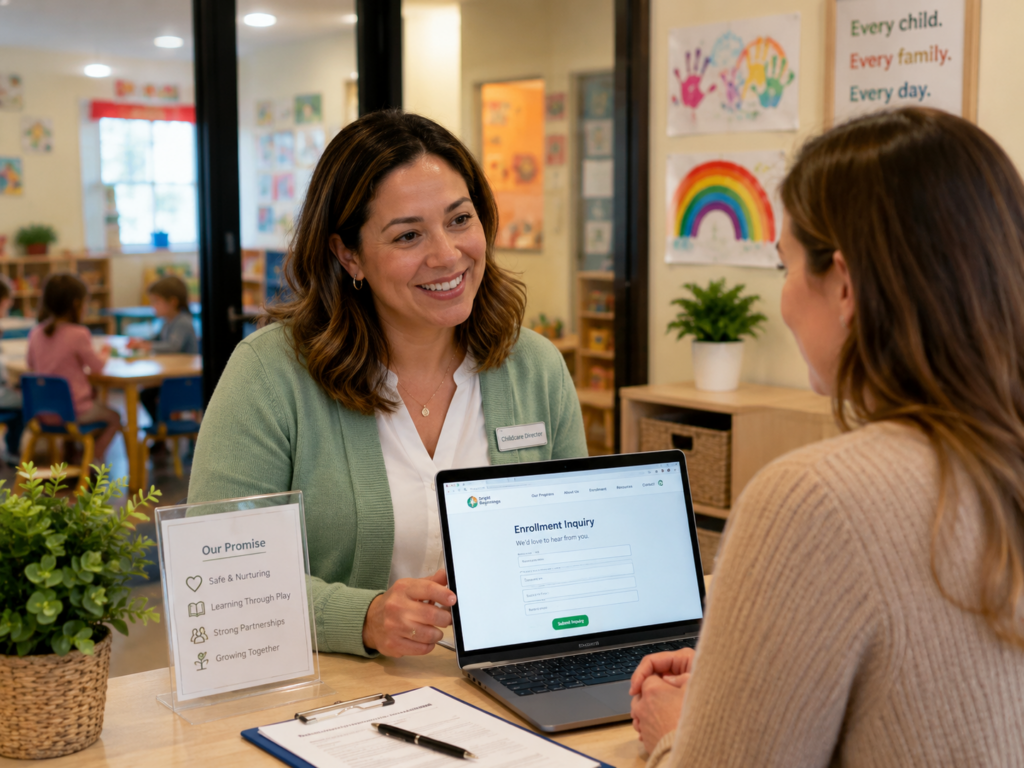
A parent may visit your website at 10:30 at night after the baby is asleep.
They are tired. They are comparing options. They may already feel stressed about money, schedules, work, and finding someone they can trust with their child.
If they cannot quickly figure out your ages served, your location, your schedule options, your general tuition approach, or how to request a tour, you may lose them.
Your website does not need to be fancy.
It needs to answer four questions clearly:
Who are you?
Who do you serve?
Where are you located?
What should the parent do next?
That is it.
A simple, clear website will often do more for enrollment than a beautiful website that leaves parents confused.
Your Tour Process Matters More Than You Think
Tours are where families decide.
A strong tour should feel calm, warm, honest, and specific. It should let the family feel the environment, understand the rhythm of the day, and see how the provider communicates.
You do not have to oversell.
In fact, overselling can make parents uncomfortable.
Instead of saying, “We have a great curriculum,” explain what that means in real life.
Tell them how children are greeted in the morning. Tell them how teachers handle transitions. Tell them how you communicate with parents. Tell them what happens when a child is having a hard day.
Families are not only buying a schedule.
They are choosing trust.
At the end of the tour, give them a clear next step. That might be an enrollment packet, a waitlist form, a deposit, or a follow-up call.
Do not leave the family wondering what happens next.
Be Honest About Price
Families are already thinking about price.
When tuition is hidden until the end of the tour, it can make everyone uncomfortable. Parents may feel embarrassed asking. Providers may spend time touring families who cannot realistically afford the program.
Childcare affordability remains a real issue for families nationwide, and parents are often comparing care options under pressure.
Being transparent does not mean lowering your value.
It means respecting people’s time.
You can post a tuition range. You can explain that rates depend on age group and schedule. You can say that families should contact the center for exact pricing.
But give parents enough information to know whether your program may fit their budget.
The families you want are the families who choose you with their eyes open.
Design for Affordability Without Racing to the Bottom
There is a difference between being affordable and being cheap.
Providers still have payroll, rent, insurance, food, supplies, utilities, licensing responsibilities, and staffing costs. First Five Years Fund reported that rising operating costs continue to put pressure on childcare providers, especially programs already working with thin margins.
So the answer is not always to lower your rates.
The answer is to design smarter options when possible.
A sibling discount may help a family stay.
A four-day schedule may work better than losing the family completely.
A partial-week option may open the door for a parent who does not need full-time care.
A small scholarship fund, community partnership, church connection, or local employer relationship may help support families without weakening the whole business.
The goal is to create flexibility without destroying your margins.
Do Not Compete on Price Alone
There will almost always be someone cheaper.
If you compete only on price, you will eventually be pulled into a race that is hard to win.
Compete on what is harder to copy.
Relationship.
Stability.
Communication.
A clean and calm environment.
A teacher who knows the child.
A director who answers questions.
A program that feels safe, organized, and personal.
That is what families remember.
That is what families talk about.
And in a tight year, that is what helps a family say, “We are going to keep this care because it matters.”
Stay Visible in the Community
Enrollment does not only happen online.
It also happens in real life.
Show up where families already are. Library story time. Family resource events. Local school events. Community baby fairs. Church gatherings. Neighborhood events.
Bring a simple flyer. Make sure it says who you are, what ages you serve, where you are located, and how families can request a tour.
The family that fills your toddler spot six months from now may be meeting you today.
Community visibility builds trust before a parent ever needs care.
Talk to Your Current Families About Openings
Sometimes providers forget to tell their own families when spots are available.
That is a missed opportunity.
You can say something simple:
“We have two toddler spots opening in January. If you know a family looking for care, please send them our way.”
That is not pushy.
That is an invitation.
Happy families are usually glad to refer people when they know you have space.
Understand the Bigger Shift Around TK
For private preschool providers, enrollment planning also has to account for California’s Transitional Kindergarten expansion.
TK enrollment in California reached 177,570 children in 2024–25, and the state increased TK enrollment by more than 100,000 children in just three years as California moved toward universal prekindergarten.
That does not mean private preschool is disappearing.
But it does mean providers have to be more intentional.
Some families may choose TK as soon as their child is eligible. Some families may stay in private preschool because they value smaller settings, longer hours, teacher relationships, flexible schedules, transportation, or continuity. Some families may need both TK and wraparound childcare.
The centers that adjust will be the ones that know exactly where they fit.
Why This Matters
Steady enrollment is not magic.
It is the result of small, consistent systems.
Families need to understand your value. Current parents need to feel proud of your program. Your website needs to be clear. Your tours need to feel warm and organized. Your pricing needs to be honest. Your community needs to know you exist.
In a tight year, families are not just looking for childcare.
They are looking for a place they can trust with one of the most important parts of their life.
That trust is what keeps enrollment steady.
Final Thoughts
Building steady enrollment when families are stretched thin is not about being the cheapest center in town.
It is about being the clearest.
The most trusted.
The most consistent.
The most connected.
When families know who you are, what you offer, and why your program matters, they are more likely to choose you — and more likely to stay.
Get the boring work right, and the enrollment math becomes a lot less stressful.